The Impending Cognitive Hack: The Limits of State Power in the Age of AI
AI and modern algorithms are on the verge of hacking human cognition, but is state censorship the right antidote? Discover why the government is structurally limited in stopping fake news, and how we can counter this impending threat without sacrificing our constitutional liberty. A deep legal analysis on Law Mystic.
EDUCATIONLEGAL AWARENESS
Balram Mishra
6/18/20267 min read
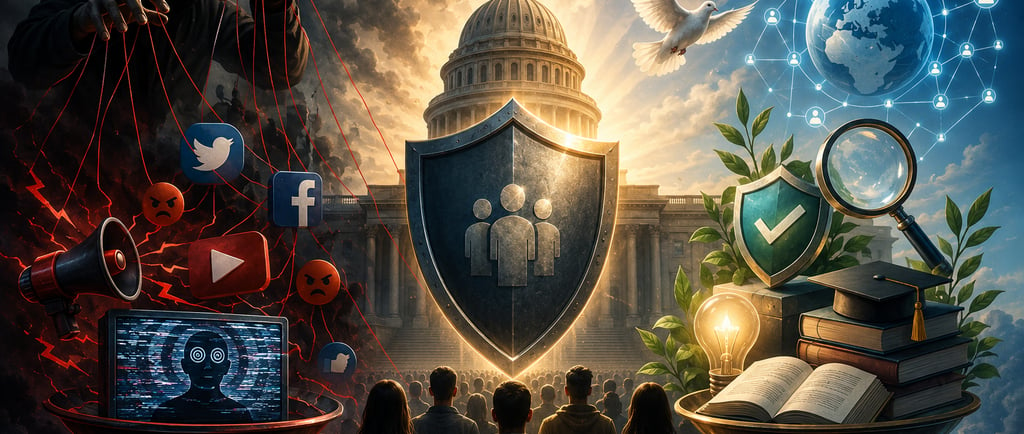
The state duty to protect citizens from misinformation.
1. "The Algorithmic Alchemist: Data Engineering and the State Mandate to Protect
Democratic Autonomy"
1.1 "The Anatomy of Autonomy: Making Citizens Truly Free"
According to John Locke, the ‘progenitor of modern natural rights theory’, human beings possess three fundamental rights: the right to life, liberty, and property.
The idea of free speech and expression has a direct nexus with these rights, as it is an integral part of the right to liberty. When these rights are meaningfully protected, only then it is possible to foster an environment where free thinkers and self-determining citizens can flourish. Reliable information is the cornerstone of this liberty; a misinformed person can never become truly free; the belief he forms is not his own, but instead shaped by external manipulation.
1.2 An Emerging Crisis of Algorithmic Control
In 2018, former Cambridge Analytica data scientist Christopher Wylie exposed the scandal in which Facebook allowed third-party access to its user database, and that third-party quiz application harvested data not only from those who participated in the quiz but also from their friends by exploiting a loophole in the API system of Facebook. All this data found its way into the hands of Cambridge Analytica, which then, by leveraging this data, made a detailed psychographic profile of voters and exploited their beliefs, fears, and psychological vulnerabilities and turned their digital footprints into a tool to mould their perceptions.
Democracy assumes people can have different opinions but from roughly the same set of facts. This incident not only challenges that assumption but also attempts to subvert it.
However, the scale and potency of its impact are debatable; it is a serious attempt to pervert the core concept of democracy by eroding the self-determination of a person by tailoring information and delivering it precisely to the right people at the right time. This operation is alleged to have operated in two of the most established democracies of the world, the United States during the 2016 presidential election, and the United Kingdom during the Brexit referendum.
1.3 Protection of the raison d'être of democracy and the state's duty to intervene.
This systematic engineering of voters’ perceptions and an attempt to make individuals' self-determination a puppet of an algorithm raises a fundamental question: to what extent is the state obligated to intervene while remaining within its constitutional limits?
In his book "Two Treatises of Civil Government" (1689), John Locke remarked that: "The great and chief end, therefore, of men's uniting into Commonwealths, and putting themselves under Government, is the Preservation of their Property” (here property means Life, Liberty, and Estate). Hence, there is a compelling duty of the state to protect its citizens' rights by applying a calibrated and proportionate regulatory framework that remains within the constitutional limits.
2. From Ancient Propaganda to the Age of Digital Deception.
2.1 A Persistent Tool of Power and Influence
The pursuit of altering the autonomy of people with the help of misinformation is not a novel practice, and a significant reason for this is that it is easier to manipulate a section of society through rumours and false narratives than to persuade them through reason and facts. The digital age and AI have propelled the process of spreading misinformation rapidly, and it aids in distorting perceptions of a large section of society at once.
2.2 The Existential Threat to Democratic Integrity
The World Economic Forum's Global Risks Reports for the years 2024 and 2025 identified misinformation as an existential threat to democracy in the near future. These institutional findings serve as a warning that, along with AI’s advancement, the reach of misinformation will rise significantly. Consequently, the citizens will lose their ability to form independent political choices, and this erosion of independent thinking could undermine the democratic ethos. Early signs of this threat are already visible, as it was observed during Brazil's 2022 presidential election, where hoaxers engaged in defaming democratic institutions like TSE and casting doubt on the integrity of the EVM system. We witnessed the replication and amplification of the same strategy on a massive scale in the world's largest democratic event, India’s 2024 general election. A vast amount of digitally fabricated content featuring celebrities criticising the government went viral on social media. The Indonesian elections in the same year mirrored this trend, with several deepfake videos, including one featuring late ex-President Suharto, who died in 2008, endorsing a political campaign. As these technologies are evolving exponentially, in the near future, they will blur the line between reality and fabrication.
2.3 The "Infodemic" and the Breakdown of Public Trust
The problem of misinformation affects multiple domains of society. Along with its adverse effects on democratic elections and voters' beliefs, it also poses a serious risk to public health and can erode trust in institutions, public authority and verifiable facts. This is not merely a theoretical concern. During the COVID-19 pandemic, a vast quantity of misinformation spread alongside the virus. Many individuals refused validated medical advice, while in several jurisdictions, health workers became targets of violence. This incident illustrates how a public health crisis can be accompanied by an infodemic and aggravate societal consequences.
3. The Classical Objection: Liberty, Censorship and the Marketplace of Ideas
3.1 The Millian Defence of Free Expression: The Threat of State Censorship
John Stuart Mill, in his book On Liberty (1859), discussed the core principles of free expression—a concept from which the doctrine of Marketplace of Ideas evolves. In which he argued that silencing any opinion, even a false one, is wrong because knowledge itself arises from the collision of truth with error. He believed that allowing ideas to compete freely in public debate is the most reliable means of discovering truth.
This foundation of free speech laid down by Mill later emerged in the US Constitution by the celebrated opinion of Justice Oliver Wendell Holmes Jr in the case of Abrams v. United States. Justice Holmes stated that: "The best test of truth is the power of the thought to get itself accepted in the competition of the market." From this, the idea emerged that the government should not act as the ultimate censor of information and that the response to misinformation is more speech.
3.2 The Real Danger: When the State Becomes the Problem
Contemporary experience demonstrates the theory that anti-misinformation measures can sometimes evolve into instruments of censorship and political control.
During the Russian invasion of Ukraine, the Russian legislature passed a criminal code stating that any reporting calling the invasion a "war" rather than a "special military operation" would prescribe a punishment of up to 15 years in prison. Additionally, several websites were blocked. Critics view this not as protection of citizens from misinformation, but as a state-manufactured narrative.
An international media advocacy organisation, Reporters Without Borders (RSF), in its latest report, levelled severe criticism against Turkey’s legislature for passing a law against misinformation without defining the term. The law gives the statewide powers to decide the factual correctness of information.
Several journalists were prosecuted for reporting on sensitive issues critical of the government. Many journalists believed that any information not approved by the government, or that criticised government policies, could easily be labelled as false.
Hungary provides another example of how a sovereign can control information. Under Prime Minister Viktor Orban, the government has limited the power of independent media and replaced it with state-friendly media outlets. Today, pro-government media houses hold significant influence in Hungary. While the government frames this as an attempt to protect citizens from foreign misinformation, the opposition views it as a move to turn the media into a tool of political propaganda that continuously runs a state-backed agenda.
The fear behind Mill’s argument is realised here: by giving the state the power to decide what is true or false, one effectively grants it the power to decide what is allowed to be said. It is not protection from misinformation; it is censorship by a different name.
4. The Democratic Alternatives.
4.1 Shifting Accountability: Platform Regulation over Content Censorship
According to Jürgen Habermas, democracy requires rational public discussion, but misinformation distorts this public realm.
To address this fundamental challenge of misinformation, within the boundaries of democratic principles, the state must avoid the peril of becoming the ultimate arbiter of truth, while ensuring it does not renege on its foundational obligations.
The European Union's Digital Services Act of 2022 adopt a highly reasonable approach towards protecting citizens from misinformation; instead of conferring statutory power to the government to filter information, it imposes a legal obligation on hosting platforms to transparently disclose information about their recommendation algorithms, allow independent researchers access to their data, and label AI-generated content, deepfake videos, and manipulated media.
Similarly, Australia's Online Safety Act, Canada's Online Harms Act, and emerging frameworks in India, Brazil, and South Korea are all taking legislative steps to achieve the shared goal of protecting citizens from misinformation.
4.2 Building Societal Resilience through Structural Interventions
Along with these steps, it is the duty of the state to invest in measures that originally reduce misinformation, and some of these measures are:
• Investing in well-funded independent journalism helps to cope with this problem.
• Media literacy programmes in schools and universities, and educational camps amongst citizens, to increase their ability to distinguish misinformation from authentic information.
• Establishing fact-checking organisations that are structurally free from political pressure.
5. Conclusion: The Oldest Duty, A New Frontier
Misinformation is an inherent vice of a democratic state. It is not merely a problem of false information, but a systemic rot challenging the autonomy and original beliefs of citizens, which ultimately affects the basic principles behind democracy.
This foundational problem of democracy cannot be solved when the state bears unchecked power and becomes the arbitrator of facts. History repeatedly demonstrates that whenever governments are given the authority to determine what is true and what is false, the solution becomes more harmful than the problem itself. Also, the state cannot remain a passive spectator due to its foundational mandate.
As per international human rights law and digital governance standards, a state can intervene in the basic regulation of information only when it satisfies the five-fold test of legality, necessity, strict proportionality, transparency, and independent judicial oversight.
Therefore, the main responsibility of the state is to create an information environment in which independent ideas can flourish, and to foster a fair competition between truth and misinformation, where misinformation is tackled by counterarguments and not by arbitrary restrictions. Also, the state should provide media literacy to its citizens, and platforms should be held accountable for conducting independent audits of the systems they design and operate.
The objective should not be to erase false information, but to ensure that public belief is not affected by manipulation and deception.
The challenge of misinformation may be new, but the democratic response lies neither in absolute state control nor in complete regulatory absence. The duty of the state remains the same as it has always been: to adopt a calibrated framework, and to protect not only individual liberty but also the very raison d'être of democracy itself.